
Every site they sold went through two founders. That was the ceiling.
A US agency builds multi-page websites for epoxy & concrete-coatings contractors. They were never short on demand — they were short on hours, because only the two founders could push each 25–70 page site through to their quality bar. The more they sold, the deeper the backlog got. We mapped their entire process and rebuilt it as a semi-autonomous cascade they trigger from Discord and run on their own server.
Weeks → days
signed to first drafts
25–70 pages
per client site, not one landing page
One command
kicks off the whole build
Owned server
they keep the system, data & control
The challenge
Demand was never the problem. Delivery was.
Every contractor site is a real build — 25 to 70 pages of services, locations, education and trust content, not a single landing page. And the quality bar was personal: only the founders could tell whether a page truly read like their work.
Generic AI made it worse, not better. It happily produces pages that score well and feel nothing like their brand. So growth stayed capped by founder hours — the more clients they won, the deeper the production backlog got.
What we mapped
We mirrored their operation — then handed it back as a system.
Their process, not a template
We mirrored the entire internal flow — intake, client research, page planning, drafting, SEO, QA, review — into one documented operating model.
Their quality bar, captured
We pulled their definition of “good” from real past work and counter-examples, so the system pattern-matches their standard instead of generic AI defaults.
One trigger, whole cascade
One command kicks off the whole cascade — from intake to a designer-ready brief to delivered, on-brand drafts.
The system · an automated cascade
From a Discord command to a delivered, on-brand draft set.
An automated, multi-stage cascade, triggered from the channel they already work in — with a live audit trail and human review where it matters.
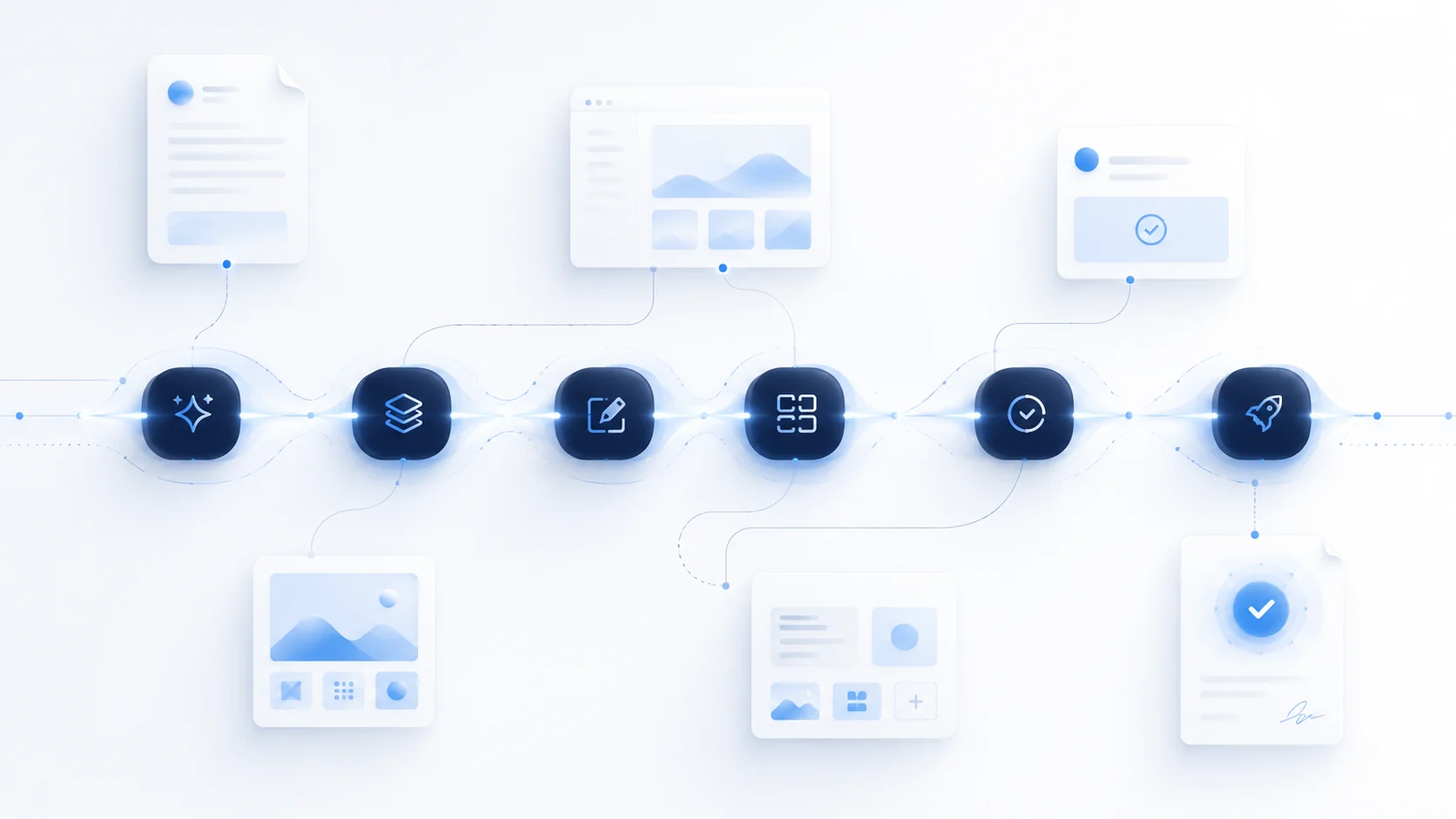
How the build works
Their design, extended by the system — never drifting off-brand.
Full-AI site builders all hit the same wall: design. So we drew the line where the human matters — their designer hand-builds the core pages, and the system extends the rest mostly hands-off, inheriting the exact look instead of guessing at it.
01
Onboarding cascade
Intake and research become a single structured, designer-ready brief — automatically.
02
Hybrid design model
Their designer builds the core look; the system extends every other page from it, so it never drifts off-brand.
03
Production pipeline
Pages are drafted to their standard, SEO-scored, and human-reviewed before anything ships.
04
Owned & logged
Runs on infrastructure they own, with a human-review gate at every stage.
The math
Most of the build team’s work, automated. Designers kept.
Delivery capacity was the ceiling — not leads. The system absorbed the bulk of the build work, so the same team ships several times the sites it used to. It drove a large step-up in monthly build capacity, the design team stayed, and most of the build team’s workload was automated away.
Several times
the sites, same team
Large step-up
in monthly build capacity
Major lift
in annual capacity
Most
of the build team’s workload automated
Figures shown as client-confirmed ranges; exact numbers withheld pending client approval.
The proof
Validated on a real brand before it shipped.
We stress-tested the model on a real epoxy brand’s site: rebuild the core pages, then generate brand-new pages from the same system and measure parity. Because generated pages inherit the same section library, they don’t re-attempt brand fit — they’re born with it.
High
core-page reproduction
Strong
brand parity on generated pages
Every section
drafted to its own budget
Days
signed → first on-brand drafts
Client anonymized under NDA. Figures describe the production system and a pre-launch validation build; per-client commercial terms are confidential. See our fully-named flagship case study →
Capacity-capped, not demand-capped?
If your delivery line is the ceiling — and quality is too personal to hand to generic AI — we’ll map your process and rebuild it as a system you own and trigger yourself. We agree on a target up front and keep building until it’s hit.
Free teardown · 2 build slots + 2 advisory retainer seats · Build-Until-It-Works guarantee